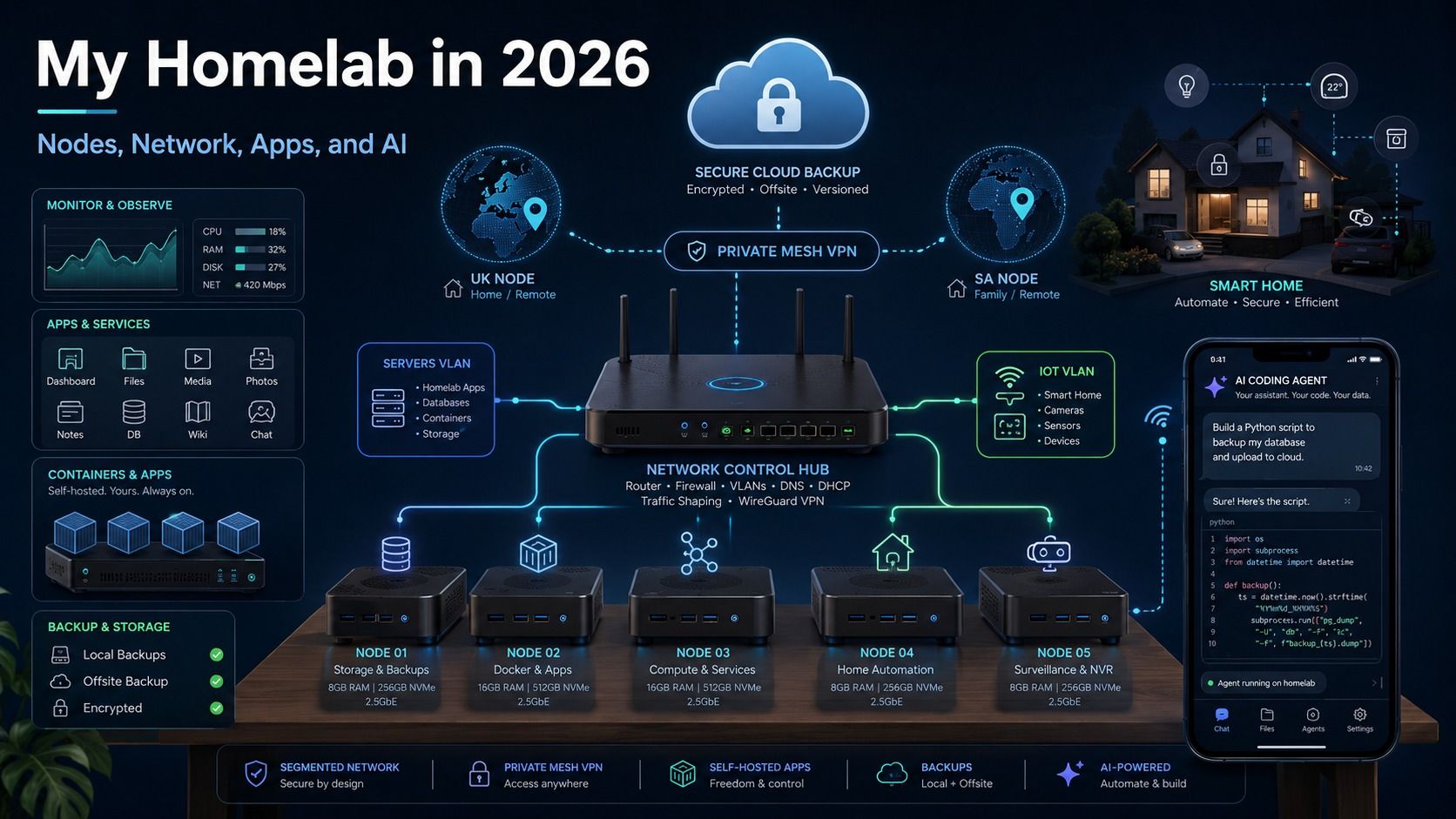
My homelab started in 2023 with a few low-power boxes. It’s grown since — but it hasn’t changed philosophy. It’s still built on small mini PCs instead of rack-mount enterprise hardware. What’s changed is how much the fleet now does: my own UniFi network with real VLANs, a handful of Proxmox nodes spread across two continents, a mesh VPN connecting all of it, a pile of self-hosted apps, and an AI layer that runs my coding agents for me.
This is the 2026 overview.
Approach
- Small, low-power compute nodes instead of one big server
- A few Proxmox nodes across the UK and South Africa
- One private mesh network (Tailscale) covering every machine
- A UniFi network at home with segmented VLANs
- Cloudflare Tunnel for the small set of services that need to be public
- Cloud storage as the backup edge
Compute: a handful of Proxmox nodes
Nothing exotic — every node is a low-power desktop mini PC running Proxmox VE. They’re cheap, quiet, and sip power, and there are enough of them that losing any one box isn’t an incident.
- The main node at home. Hosts the Docker workhorse — a VM running most of my containerised services and the control point for the whole fleet — plus my home automation instance and file sync.
- The coding node at home. Dev VMs and app servers, including my coding-agent setup and a local database for development.
- A node at family in South Africa. Runs their home automation and a small Docker VM, and acts as a Tailscale exit node — a stable route home from anywhere.
- A couple of small cloud VMs for the things that need a fixed public presence (a database and a voice server).
- An old NAS at my parents’ place for family file storage and backups.
Network: UniFi + Tailscale + Cloudflare
UniFi at home
My network is UniFi, with a UDM Pro as the control centre. A couple of access points cover the house, and everything — Wi-Fi, smart-home devices, cameras, guests, and the homelab itself — sits on its own VLAN so devices only talk to what they actually need to. Two WAN connections give me automatic failover, and there’s a single place to see every device and block what shouldn’t be there.
Tailscale as the backbone
The clever bit is how the whole fleet is glued together: Tailscale. Every node — the Proxmox hosts, VMs, cloud servers, my laptop, my phone — lives on one private mesh network. Services bind to tailnet addresses rather than the public internet, and the exit node in South Africa gives me (and family) a reliable way to reach everything from anywhere.
Cloudflare Tunnel for the public side
Anything that genuinely needs to be reachable from the internet goes through a Cloudflare Tunnel, so no ports are opened on the home router. Public hostnames terminate on the tunnel and reach the apps internally, with Cloudflare Access in front of anything sensitive.
Apps running
One Docker VM runs the bulk of my services. The standouts:
| App | What it does |
|---|---|
| Homarr | dashboard landing page for the lab |
| n8n | workflow automation between services |
| Forgejo | self-hosted Git |
| Prefect | scheduled data pipelines for my personal and finance data |
| Syncthing | real-time sync of my notes vaults |
| ntfy | self-hosted push notifications |
| Uptime Kuma | uptime monitoring across the fleet |
| Beszel | lightweight resource monitoring |
| Wiki.js | internal documentation |
| IT-Tools | the everyday utilities |
A cloud VM hosts the database that the pipelines feed into, plus the voice server.
AI infrastructure
This is the part that’s grown the most. I’ve built a small AI layer across the fleet:
Coding agents from anywhere. The heart of this is T3 Code — a self-hosted coding server that powers an iOS app. It runs on a couple of machines on the tailnet, so there’s always one reachable and the app can talk to whichever is available. That means I can delegate coding work to my real infrastructure from my phone, wherever I am. Both instances carry the usual provider CLIs — Claude Code, Codex, OpenCode Go — all authenticated locally.
Persistent remote-control agents. Claude Code and Codex run as always-on services across a few nodes, so sessions survive reboots and disconnects. Effectively a set of on-call coding agents I can call on at any time.
A contained agent for family. On the South Africa node there’s a locked-down agent that works only inside a shared family notes vault — scoped by filesystem and firewall rules so it can never reach the rest of the network.
An AI routing policy. Instead of one model doing everything, I route work deliberately: one agent orchestrates and owns the final answer; a cheaper model handles bulk work; and harder models are the escalation path for high-risk changes. Everything auto-updates on a schedule.
Storage and backup
- Every VM is snapshotted weekly and pushed to cloud storage.
- The NAS at my parents’ place mirrors the family laptops and pushes a weekly copy to the cloud.
- My notes vaults sync live, with a version-controlled weekly backup.
- Disk health is monitored continuously on the storage boxes.
Home automation
Home Assistant runs on its own VM and has become the thing the family actually notices. A Zigbee coordinator handles the wireless sensors and switches, Matter covers the newer smart-home gear, and a HomeKit bridge selectively exposes the useful stuff to Apple Home — the climate control, the appliances, the sensors, and the TVs.
Why it works
The same reasons as 2023, just scaled up:
- Low-power nodes, not one big server — reliable without enterprise hardware or enterprise power bills.
- A mesh VPN as the backbone — Tailscale makes remote access a solved problem, and exit nodes turn family machines into part of my network.
- Cloudflare as the edge — public services without poking holes in the home firewall.
- Segmented networking — VLANs keep IoT, cameras, guests, and servers apart, manageable from one controller.
- AI as infrastructure — the agents, watchdogs, and routing policy have turned my homelab into a place that actively builds things, not just hosts them.